






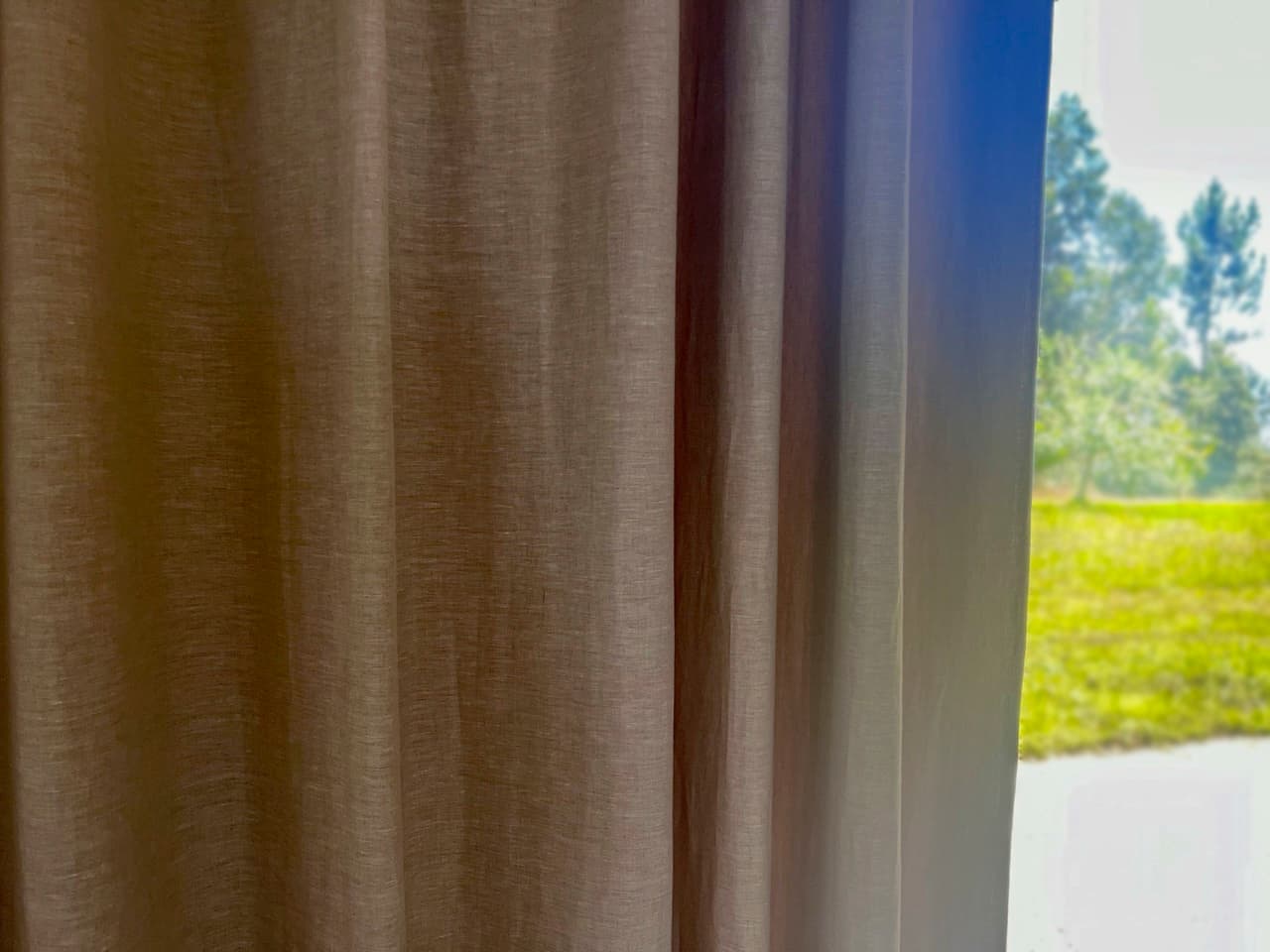
Not sure whether to choose 100% linen or a linen blend for your curtains? Start by considering how much daylight you want, how much privacy you need in the evening, and how the fabric will look at your window. Pure Linen is a fluid-drape fabric made from 100% linen and weighs 160 g/m². Palermo contains 10% linen and 90% polyester and weighs 290 g/m²; the fabric page describes it as sturdy and crease-resistant. You can compare sheer curtains as a lightweight layer for daytime.
You’ll only really see which fabric works best at your own window. That’s why this guide includes a comparison of all our curtain fabrics, a quick check for light gaps, color advice for walls, floors and sofas, and a checklist for testing swatches at home in daylight and lamplight.
In brief
- Fluid drape and 100% linen: Pure Linen.
- Comparing linen blends: Evora (30% linen), Marseille (20% linen) and Palermo (10% linen) each have their own composition and texture.
- Filtering light during the day: compare the details for Elegance Vitrage and Milano Vitrage, and note where people can see in through your current window.
- More darkness or privacy in the evening: a fabric with Luna lining (up to 80% blackout) or Eclipse lining (100% blackout).
- Not sure? Compare swatches at your own window for color and texture, in daylight and lamplight.
100% linen or a linen blend: what difference does it make at the window?
Pure linen and linen blends differ in composition. Pure Linen contains 100% linen; Palermo contains 10% linen and 90% polyester. Compare the color and texture of the specific fabrics using swatches, and don’t infer drape, privacy or care requirements from the linen percentage alone.

-
Drape: Pure Linen is described as having a fluid drape. Palermo is a sturdy fabric; compare the swatches to see which feel and texture you like.
-
Light: an unlined fabric can filter daylight. How much light passes through also depends on the weave, color and finish; weight alone doesn’t prove that.
-
Creasing: the fabric page describes Palermo as crease-resistant. This isn’t a comparative test with Pure Linen, nor a property that can automatically be attributed to every linen blend.
-
Care: follow the instructions for the complete curtain, including any lining. The composition alone doesn’t determine which treatment is allowed.
A fabric with a “linen look” doesn’t have to contain linen. So always check the composition of the curtain fabrics, not just the photo.
Our curtain fabrics side by side

This table compares the fabrics in our collection. Weight helps compare the fabric’s density, but on its own doesn’t prove how much light or visibility a curtain blocks.
|
Fabric |
Composition |
Weight |
Max. height |
Light and appearance |
Works well with |
|
Pure Linen |
100% linen |
160 g/m² |
280 cm |
Drapes smoothly |
Living room, dining room, north-facing rooms |
|
Evora |
30% linen, 70% polyester |
220 g/m² |
280 cm |
Light texture with a soft drape |
Living room, home office |
|
Marseille |
20% linen, 80% polyester |
270 g/m² |
280 cm |
Sturdy; also available with vertical stripes |
Rooms where you want an accent |
|
Palermo |
10% linen, 90% polyester |
290 g/m² |
280 cm |
Sturdy and crease-resistant |
Bedroom, street-facing, large windows |
|
Elegance Vitrage |
44% linen, 9% viscose, 47% polyester |
100 g/m² |
300 cm |
Light-filtering with a subtle sheen |
Light layer for daytime |
|
Milano Sheer Curtain |
100% polyester |
not specified |
310 cm |
Very sheer |
Maximum daylight, tall windows |
For greater blackout, you can pair a suitable curtain fabric with Luna or Eclipse. The fabric page and the wave product page state that Luna reduces light by up to 80%; Eclipse is a fully blackout lining. The amount of light that comes in around the edges depends on how the curtain is hung. Check which combination is available for your chosen face fabric, or choose a separate, tightly woven evening curtain.
Palermo or Pure Linen: which should you choose?
Compare Pure Linen if you’re looking for 100% linen, and Palermo if you want to check that fabric’s composition and sturdy texture. Pure Linen weighs 160 g/m² and Palermo 290 g/m². This weight difference doesn’t prove a difference in evening privacy or creasing. Check the texture and light transmission at your own window, and assess the lining you want separately.
Light-filtering or blackout curtains?
Which curtain fabric lets in plenty of light, and when should you choose blackout curtains? The fabric determines how much light comes in, but the lining and how the curtain is hung determine how dark the room actually gets. So start with what you need in that room.

-
To let in plenty of light: compare an unlined Pure Linen curtain or a voile at your window. Check the color and transparency in the daylight you actually get there.
-
Which curtains help with strong sunlight? Compare the face fabric with a suitable Luna or Eclipse lining. The fabric page states up to 80% light reduction for Luna and complete light blocking with Eclipse. Also check for gaps around your window; these figures are not a UV test of the face fabric.
-
Which curtains blackout a bedroom? Choose the Eclipse lining (100% blackout). Also pay attention to the edges: even with a fully blackout lining, light can come in around the top and sides.
-
For daylight and reduced visibility from outside, voile or semi-sheer curtains may be suitable, depending on the fabric and lighting. Read more about privacy with semi-sheer curtains, including in the evening.
Quick check: where is the light coming in?
A blackout lining only works well if the curtain also fits properly. Check these three points:

-
Top: is the rail mounted just below the ceiling, or is there a gap between the rail and the ceiling that lets light through?
-
Sides: check that the curtain overlaps the window sufficiently when closed. How much extra space is needed depends on the rail, the distance from the wall, and the available space beside the window.
-
Bottom: does the curtain reach just above the floor, or is there a strip of light left above the windowsill?
Home office: test for glare
Having trouble with glare on your screen? First check when direct sunlight falls on it and whether you can reposition your desk. A small swatch helps you assess the color and texture, but it won't show how much glare a full curtain will reduce. Before ordering, ask for advice on a suitable combination of fabric and lining for your workspace.
Color to match your walls, floor and sofa
The color of linen can look different as the light changes. A shade that looks cool in a photo may appear warmer by your window. Use these ideas as a starting point, then check with a swatch.

-
What color curtains go with a beige wall? Choose a shade that’s slightly lighter or darker than the wall, such as off-white or mocha. An exact match makes the curtain blend in, which can quickly look flat.
-
Beige, sand or off-white? Off-white keeps the room brightest and works well with cool daylight. Sand and beige add warmth and pair well with oak, rattan and wool.
-
How do you choose a curtain color to go with your floor? Sand and white create a calm look with light wood floors. With a dark floor, a mid-tone such as mocha or greige makes for a softer transition than bright white.
-
How do you coordinate curtains with your sofa? Don’t match the sofa color exactly; choose a shade from the same color family instead. A sand-colored sofa with off-white curtains feels coordinated without looking like one big block of color.
Examples: which fabric for which room?
The same fabric behaves differently in every room. These examples can help you find a match for your own situation.
|
Situation |
What to consider |
Good choice |
|
Cozy living room, evening lamplight |
Warmth and soft folds |
Palermo in sand or mocha, floor-length, optionally with Elegance Vitrage behind it |
|
Dark, north-facing room |
Keep every bit of daylight |
Pure Linen in white, without lining |
|
Street-facing bedroom |
Privacy and blackout |
Palermo or Pure Linen with Eclipse lining, ceiling-mounted track |
|
Clean, modern interior |
Contrast with smooth fabrics |
Pure Linen or Evora: compare their texture with a swatch next to your smooth fabrics |
|
South-facing home office |
Bright light and glare |
A light-filtering sheer for daytime, with a denser curtain for the brightest hours |
How do you make a living room cozy with curtains? Let them hang to the floor, hang them wider than the window, and choose a warm, medium-weight fabric. In the evening, with the lights on, a closed curtain gives the room a cocooning feel. During the day, open it and let a sheer curtain soften the light.
How to test curtain fabrics at home: a checklist for swatches
View curtain swatches against the window to compare color, texture, and light filtration. You can request up to 7 free swatches at a time; any packaging and shipping costs will be shown at checkout.

-
Hold the swatch against the glass, not the wall. This lets you see the light coming through the fabric.
-
View the color in daylight and under the type of lamp light you usually use.
-
A small swatch can’t confirm evening privacy. Before ordering, note where people might see in from and when you need privacy. Discuss your situation, chosen fabric, and lining with our customer service team.
-
Place it next to your floor, sofa, and wall to see whether the shade looks warmer or cooler.
-
Would you like a lining? Place a swatch of the lining behind the face fabric if you’re ordering it too. A folded swatch of the face fabric doesn’t reliably replicate a lined curtain.
-
Compare up to three options at a time, and take a photo without a filter for each test.
-
Feel the fabric: which texture and feel appeal to you?
Finishes and care at a glance
Once you’ve chosen the fabric, decide on the top finish. Wave creates even folds on a track, pleats look more classic, and rings or loops slide along a rod. Use the available finishes and the instructions for your chosen curtain as a guide.
For care, follow the washing instructions for the entire curtain, including the lining. Read our guide to caring for linen curtains for practical advice on preparation, drying, and ironing.
From choosing to ordering
Know which fabric, color, and finish you want? Then choose your made-to-measure linen curtains. Each curtain is handmade in our workshop after you order; allow 4 to 6 weeks for delivery. Read the return policy before ordering: our made-to-measure curtains can't be ordered on a trial basis and then returned.
Measure the height and width carefully before ordering. Our guide to measuring curtains correctly explains the right measuring points for your rail or pole. It also sets out the terms of our ‘Perfect-fit’ guarantee for shortening or narrowing; this doesn't apply to lengthening or widening.
Frequently asked questions about choosing linen curtains
Are linen curtains sheer?
Linen can filter daylight. A swatch shows the color and texture, but doesn't predict evening privacy. Is evening privacy important? Before ordering, ask our customer service team for advice about your chosen fabric and a suitable lining.
Can linen curtains be made blackout?
Yes, with a suitable blackout lining. Eclipse blocks light through its lining; Luna reduces light entry by up to 80%, according to our product information. Light may still come in along the top, sides, and bottom. Also check that the lining you choose is available for your fabric.
Is a linen blend less beautiful than pure linen?
Not less beautiful, just different. Pure Linen is made from 100% linen. Palermo is a blend described on the fabric page as durable and crease-resistant. Compare their color, texture, and feel with your own window.
How many swatches can I order?
You can order up to 7 swatches at a time. Choose a few in different fabrics and a few in different shades of the same fabric.
Which fabric works best in a small living room?
A light fabric in a shade close to the wall color keeps the room feeling open. Hang the rail as high as possible to make the window look larger. Find more ideas in our styling tips for a small living room.
