












Linen blend covers are often chosen because they give a natural, calm appearance without having the same effect as a completely smooth synthetic fabric. However, there are many misconceptions about this type of material. Some people think that linen blend is difficult to keep clean, always wrinkles messily, or is only suitable for sofas that are rarely used.
The doubts are understandable. The word linen quickly evokes images of a fabric that is beautiful but also delicate, prone to wrinkles, and demanding. With linen blend, it’s more nuanced. It’s not pure linen, but an upholstery fabric where the linen look or natural texture is combined with other fibers and finishes.
In this guide, we look at three common misconceptions so you can better determine if linen blend suits your sofa, interior, and lifestyle.
Misconception 1: linen blend covers are hard to clean
A common concern is that linen blend covers are complicated to maintain. People think of delicate fabrics that can only be gently hand washed or quickly lose their shape. This image mainly comes from confusion with pure linen.
Linen blend is often chosen because it can approach the calm look of linen, while the practical properties depend on the exact composition, weave, and finish. That’s why it’s important not only to look at the fabric’s name but also at the care instructions.

Always check the care label
The main rule remains simple: always follow the care label of the specific cover. Not every linen blend has the same composition, thickness, or finish. Some covers are machine washable, others require a gentler program or professional cleaning.
Preferably don’t wash a cover at too high a temperature. A low temperature, mild detergent, and gentle drying are usually safer for the fit and color. Avoid harsh cleaning agents as they can damage the fibers or finish.
The advantage of a removable cover is that it makes maintenance much clearer. You don’t have to clean the entire sofa but can treat the cover separately according to the instructions.
Small stains require quick action
Linen blend is not automatically stain-resistant. For a small stain, it’s wise to dab quickly rather than rub. Use a clean cloth and work carefully so you don’t push the stain deeper into the fabric.
If washing is needed, treat the spot first according to the care instructions. For households with children or pets, this is an important point. Linen blend can be practical, but it remains wise to assess color, texture, and maintenance together before choosing a cover.
Misconception 2: linen blend always wrinkles messily
Because pure linen is known for wrinkles, many people assume linen blend has the same problem. That’s not entirely true. Linen blend can crease and get light wrinkles, but the effect is usually calmer than pure linen.
It strongly depends on the composition, fabric thickness, and how tightly the cover fits the sofa. A well-fitting cover quickly looks neater than a loose one, even when the fabric itself has a natural texture.
A natural fold is not the same as messy
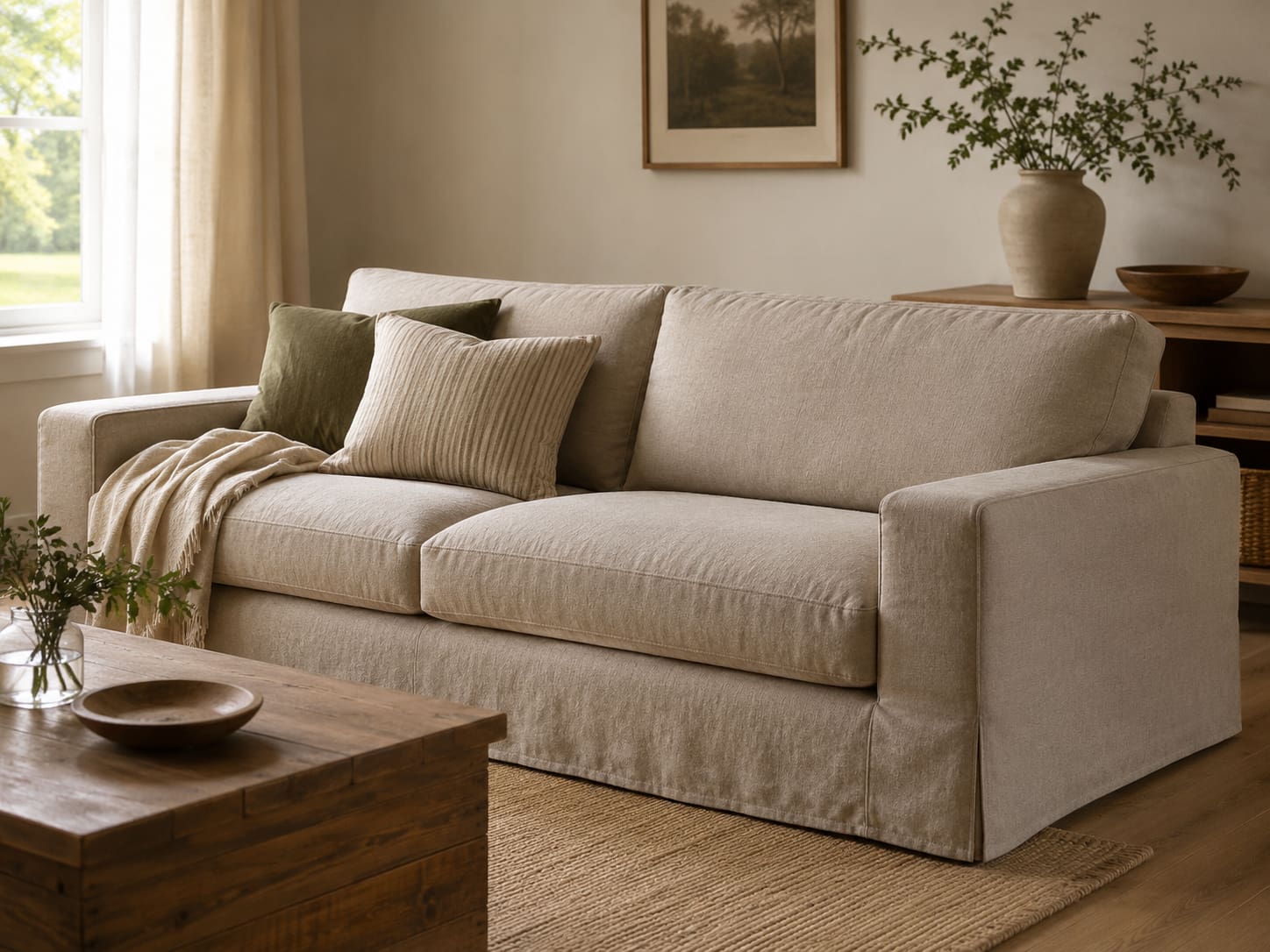
Linen blend often has a light, relaxed texture. That’s actually part of the look. The fabric doesn’t have to be completely smooth to look well cared for. A subtle fold can look natural and soft, as long as the cover stays well in place.
The problem usually doesn’t come from one wrinkle but from a combination of loose fabric, crooked seams, and uneven tension. That’s why fit is at least as important as fabric choice.
If you have a Kivik sofa and want a natural, calm look, durable linen blend covers for Kivik models can be a logical choice. Especially with wide armrests and large seating areas, a well-fitting cover helps the fabric hang neatly.
Steaming can help after washing or fitting
After washing, transporting, or refitting, linen blend may be a bit folded or wrinkled. Light steaming can help the fabric hang more smoothly. Always test first on a less visible spot and don’t use too high a temperature.
Then gently straighten the cover and distribute the fabric over the seat, back, and armrests. Often this combination makes more difference than ironing or steaming alone. The fabric should not only be smooth but also fit well around the sofa’s shape.

Misconception 3: linen blend is only suitable for calm living rooms
A more specific misconception is that linen blend is only suitable for a neat living room that is rarely used. The fabric looks great in photos but is less logical for a sofa that is used daily for sitting, reading, working, or watching TV.
That view is too limited. Linen blend can actually fit well in a normal household, as long as you choose the right variant and realistically consider maintenance, color, and use. It’s not a fabric that automatically hides or tolerates everything, but it’s also not a material that belongs only in a formal sitting room.
Daily use requires more than just a nice color
For a frequently used sofa, it’s wise not to look only at color. Also pay attention to texture, thickness, fit, and care instructions. A cover that fits well and suits your use will work better in practice than a fabric that only looks perfect in a product photo.
Linen blend can be a good middle ground if you want a natural look but prefer a fabric that wrinkles less noticeably than pure linen. If you want a very smooth, tight look, another fabric might suit better. If you want a relaxed, tactile, and timeless base, linen blend can work well.
For those unsure between different looks, the difference between a cotton look and a linen look is a useful next step. There you can better compare which visual effect fits your interior.

Match the fabric to children, pets, and light exposure
A sofa cover should fit your lifestyle. If you have young children, pets, or use the sofa intensively every day, maintenance is more important than just appearance. Then it’s better not to choose a fabric purely because it looks nice, but also consider how easy it is to clean the cover and how the color holds up in your space.
Light exposure also plays a role. Dark fabrics can look heavier in bright sunlight. Light fabrics can make a room look bigger but sometimes require more attention in a busy household. So don’t just look at the color on a screen but think about your own living room, daylight, and how often the sofa is used.
For a broader consideration, you can read more about the right material for your lifestyle. That helps you choose not only based on appearance but also on use, maintenance, and comfort.
Conclusion
Linen blend covers are sometimes misunderstood because people judge them as if they were pure linen. In reality, much depends on the composition, weave, finish, fit, and care instructions of the specific cover.
Linen blend is especially a good choice if you want a natural, calm look but don’t necessarily want the strongly wrinkled look of pure linen. It fits well in living rooms where the sofa is really used, as long as you pay attention beforehand to maintenance, color, texture, and how intensively the sofa is used.
So don’t choose linen blend just because it sounds nice, but because it fits your way of living. Then you get a cover that not only looks good but also works logically in your daily routine.
